


Death Valley

Storms, a rare superbloom, sunrise on the dunes, and a photographer’s field guide to one of the most extreme landscapes on Earth.
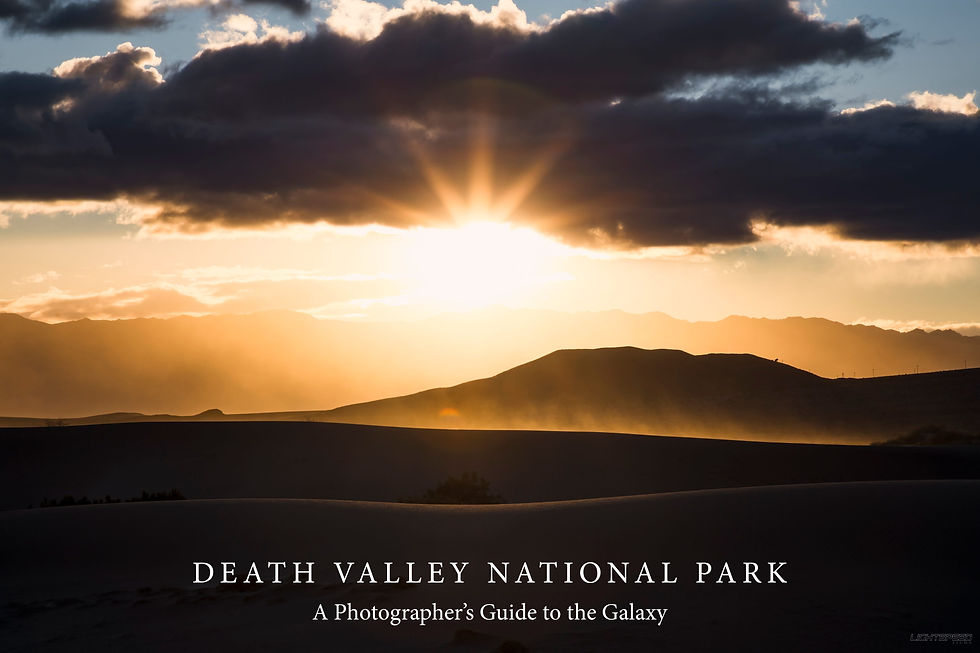
Death Valley is a portal to another world. Barren and unforgiving, yet hauntingly beautiful, it unfolds on a scale that is difficult to comprehend. Mountains rise from vast, empty basins, their slopes streaked with unexpected color. Salt flats stretch toward the horizon, while sand dunes curve and fold into landscapes that seem to belong somewhere beyond Earth. The sheer diversity is startling. Every few miles, you find yourself somewhere entirely different, wondering how all of this can exist in the same place.
It’s the closest I’ve come to feeling as though I were walking on Mars.
I’m bringing A Photographer’s Guide to the Galaxy here to The Edge of Tomorrow, beginning with Death Valley. Photography has shaped so much of how I experience the world that it feels right to give those stories a home alongside everything else I explore here. This post begins with the adventure, followed by a detailed photography guide with locations, timing, gear and practical notes for planning your own trip.
Here for just the photography guide? Jump ahead ↓
When the desert came alive
We visited Death Valley at the beginning and again at the end of an eleven-day road trip through eastern California, Nevada, Utah and Arizona, our own little Wild West loop.
On that first visit, this seemingly barren world was revealing another side of itself.
Rain was falling in Death Valley.
That alone felt remarkable. Death Valley holds the record as the hottest place on Earth and is the driest place in North America, averaging less than two inches of rain a year at Furnace Creek. Yet here we were, watching storm clouds roll through the mountains while water stretched across the basin below.
Lake Manly had returned to Badwater Basin, temporarily filling part of the salt flats with open water.
At the same time, wildflowers were beginning to emerge across the valley floor.
We had arrived during a superbloom.
Seeing any one of these things would have felt special. Seeing rain, standing water and a desert bursting into flower all at once felt almost impossible. Against the enormous, weathered landscape, the flowers looked impossibly delicate. Tiny patches of yellow, purple, and green punctuated miles of rock, salt and sand, a reminder that the desert was never really dead. It had simply been waiting.
The same weather that brought all of this life had another side.
The wind was insane.
At one point, the desert seemed to lift off the ground around us. Sand swept across the road in sheets and spun upward in violent columns, swallowing parts of the landscape as quickly as they appeared. Outside the car, it felt like being sandblasted.
The sand found everything.
Our eyes hurt. Our faces hurt. Every exposed patch of skin stung. It worked its way into our clothes, hair, camera bags and gear. There was nothing graceful about it. We were getting absolutely beaten up by Death Valley.
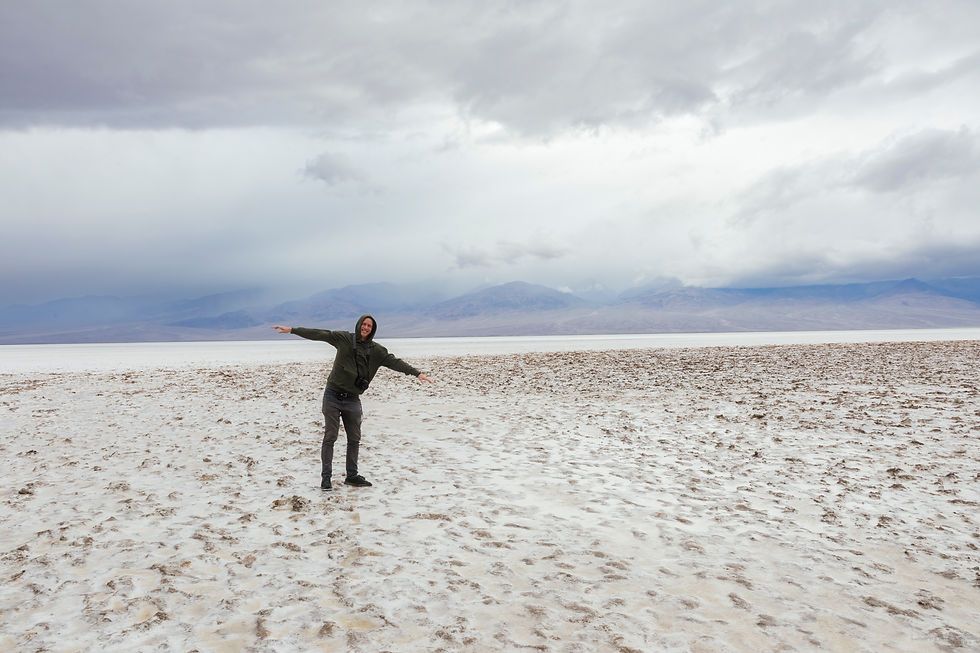
But photographically, the storm was extraordinary.
Clouds raced across the mountains. Rain darkened the rock and pulled colors from the desert that would have disappeared beneath harsh midday light. Wind continually reshaped the landscape, wiping away footprints and carving new lines into the sand.
There was something strangely beautiful about watching a place so enormous transform in real time.
Death Valley felt hostile and alive at once.
I was in love.
Sunrise on the dunes
The sand dunes had been calling my name, and reaching them for sunrise meant getting up at four in the morning to make the drive into the park. Some places are worth arranging your entire day around a few minutes of light. This turned out to be one of them.
As the sun rose, it caught the sand blowing across the dunes, illuminating countless tiny grains as they lifted and scattered through the air. It looked like fairy dust drifting over the ridgelines, briefly suspended in the morning light before settling somewhere new. The dunes themselves seemed to be moving, their edges dissolving and taking shape again as we watched.
Behind us, the wind erased our footprints almost as quickly as we made them. We could turn around and watch the evidence of our walk disappear, the sand smoothing itself back into an unbroken surface. There was something mesmerizing about seeing the landscape continually remake itself, indifferent to the small marks we left behind.
Even the sound of the sand blowing was magical. Together with the light and constant movement, it gave the morning a quality that a still photograph could only partly convey. I wanted to capture the illuminated sand, but also the feeling of standing inside it, hearing it move around us while the sun slowly revealed the shape of the dunes.
It was one of the most extraordinary places I’ve ever watched the sunrise. The view changed as the light reached each ridge, drawing out curves and shadows that had been difficult to distinguish just moments before. With the sand glowing around us and our footprints already disappearing behind us, that four-in-the-morning alarm felt like a very small price to pay.
Driving through color
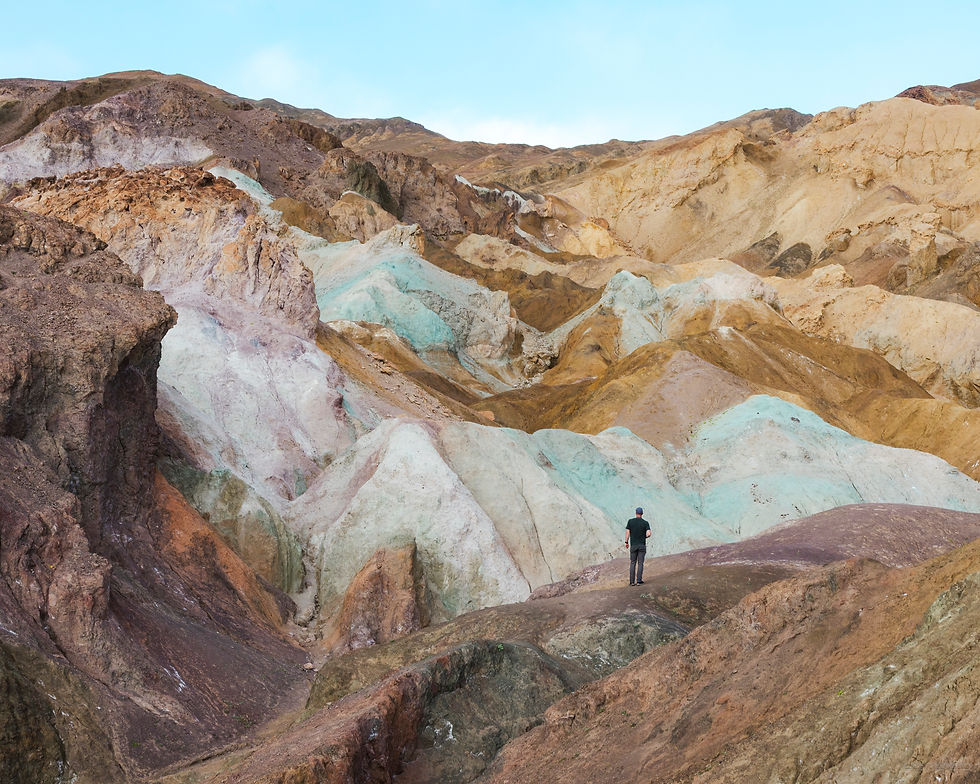
One of the strangest things about Death Valley is how abruptly the landscape changes.
You can leave endless white salt flats, drive a short distance and suddenly find yourself winding through mountains painted in shades of red, green, pink, gold and purple.
Artists Drive was one of my favorite surprises.
The nine-mile road twists through narrow canyons and colorful formations, with something new appearing around nearly every turn. The easiest comparison I can make is driving through Cars Land at California Adventure, except this is real and nature had a few million years more to work on the set design.
Artists Palette is the obvious destination along the route, where mineral deposits create some of the most concentrated color in the hills. The main overlook was crowded, so Sage and I wandered farther away and found our own place to explore. That usually ends up being where I find the photographs I like best anyway.
We had missed the rain here by roughly a day. Moisture can deepen the colors of the rock considerably, which immediately gave me another reason to return.
Eleven days later
We drove back through Death Valley just eleven days after that first trip. It might as well have been a different season. The clouds were gone. The rain was gone. The wind was gone. By midmorning, temperatures were already climbing toward 90 degrees.
The dunes that had been swept clean by the storm were now covered in days of footprints. The soft light and dramatic clouds from our first visit had been replaced by an empty blue sky and increasingly harsh desert sun. Same park. Completely different world.
That contrast might be what stayed with me most. Death Valley appears ancient and permanent, yet we watched it transform almost in real time. Wind redrew the dunes. Rain changed the mountains. Water appeared where you expected none. Flowers pushed through seemingly lifeless ground.
And eleven days later, so much of it was already gone.
There is still plenty we didn’t see: Mosaic Canyon, more remote dunes and the night photography I never got because clouds followed us through both visits. Death Valley is full of side quests, and we barely scratched the surface.
I’ll be back.
A Photographer’s Guide to the Galaxy: Death Valley
I’ve spent about fifteen years chasing light around the world, often planning entire trips around where the sun will rise, where it will set, what the weather might do, and whether hauling twenty pounds of camera gear up a mountain will actually be worth it.
These guides bring together the information I look for when planning those trips: where to shoot, when to be there, how difficult it is to reach, what gear is worth carrying, where to stay, where to eat and, perhaps most importantly, whether the photograph is worth the effort.
For Death Valley, that means sharing what worked, what didn’t, and what I’ll approach differently next time.
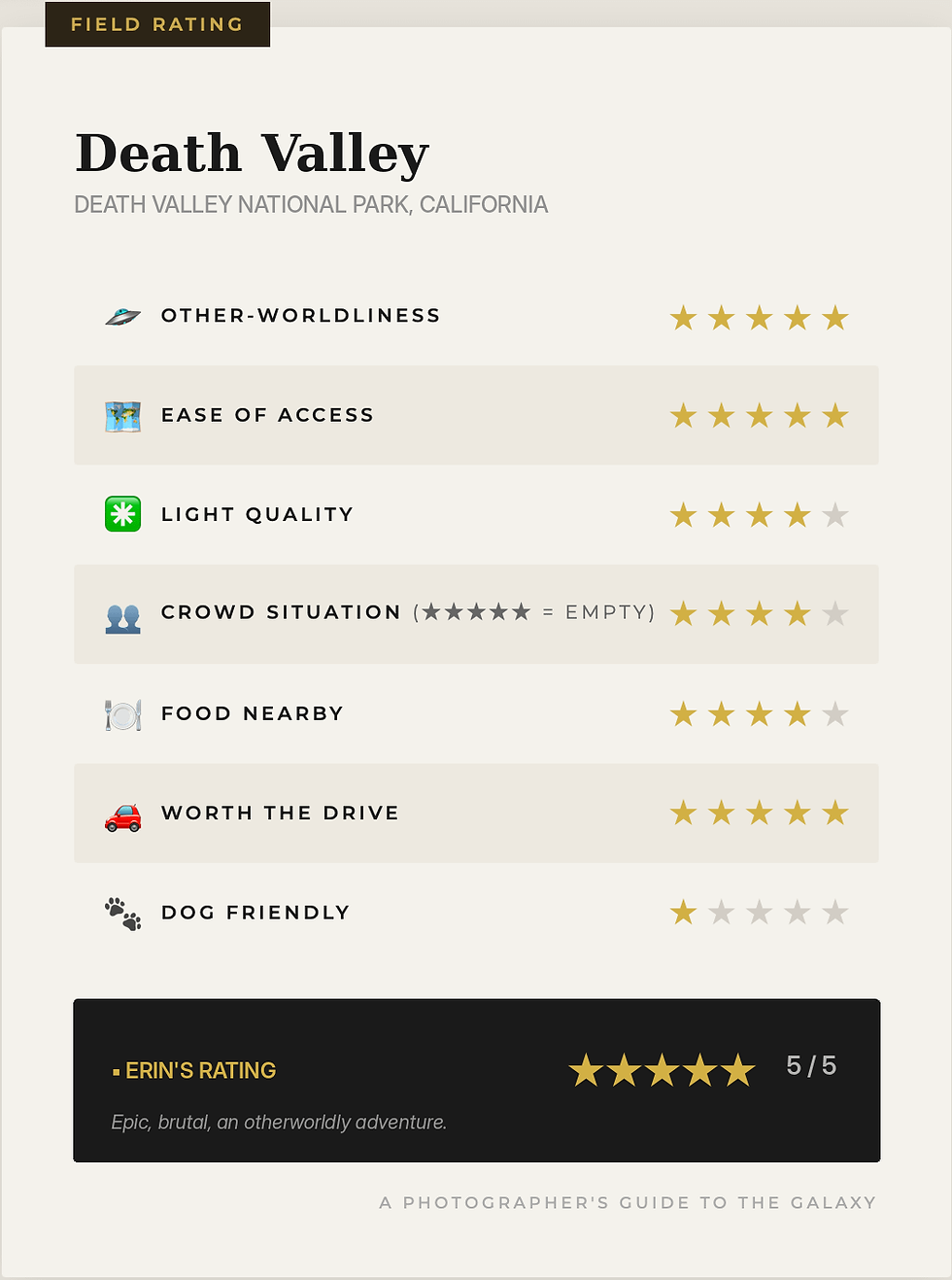
Quick Reference
Time of Year
Winter. December through February.
Mid-February is potentially the sweet spot if conditions line up. I caught a storm, the superbloom, 50 mph winds, and water in Lake Manly. It was extraordinary.
Summer is brutally hot, 120 degrees plus. It’s the hottest place on earth. Only go in summer if you are specifically there for night sky photography and you have a solid plan for the heat.
Timing: Best Light
Mesquite Flat Sand Dunes: sunrise
Golden Canyon: just after sunrise
Zabriskie Point: golden hour / sunset
Badwater Basin / Lake Manly: cloud drama and afterglow
Artists Drive / Artists Palette: late afternoon. Next level right after rain.
Light Reality
You are in the desert. The light is harsh and it moves fast.
About half an hour after sunrise it is already getting punishing.
Post-sunset afterglow is your other window.
Unless there are clouds. Clouds extend everything and turn the whole place dramatic and alive.
Gear to Bring
Wide angle (16 to 35mm): dunes, salt flats, big scenes
24–105mm: versatile workhorse for almost everything. This did most of the work.
Longer lens: worth bringing for dune compression and abstract layers
Tripod: I really didn’t use one. I’d skip it unless you are doing night photography.
Having a human in frames helps viewers actually understand the scale
What to Wear / Pack
Merino wool neck gaiter. We bought them on the trip and they were a game changer for wind and sun.
Hat, sunglasses, and a lot of sunscreen.
More water than you think you need.
Timing: Avoid Crowds
Dunes: go at sunrise. Golden hour is packed even on weekdays.
Golden Canyon: go early. I went at 10 a.m. on a Tuesday and it was crowded with harsh light.
Zabriskie Point: it will always have people. Be patient.
Artists Drive: a 9-mile scenic drive. Hike away from the main pullout at Artists Palette and find your own spot.
Badwater Basin / Lake Manly: The parking lot gets busy during the day. Early morning and evening you will have it mostly to yourself. You can also skip the lot entirely and pull off along the side of the road to walk further down the salt flats.
The Full Story
When to Go
Winter is the time. December through February. Late February gives you the best shot at cooler temperatures, storm clouds, and potential rain, which changes everything out there.
You are in the desert, so the light is harsh and it moves fast. About half an hour after sunrise it is already getting really harsh. Your real windows are that first half hour at sunrise and the afterglow after sunset. Unless there are clouds, and then the light can extend and the whole scene turns dramatic and alive. Clouds in Death Valley are everything.
Summer is dangerous. 120 degrees plus dangerous. Cars break down and so do people. Only go in summer if you are specifically there for night sky photography and you have a solid plan for the heat.
One thing worth knowing before you go: the park is enormous. From one end to the other is close to an hour of driving. At 3.4 million acres, it is the largest national park in the U.S. outside Alaska. Factor that into your planning.
A few practical things before you head in:
Gas: Fill up before you enter the park. Gas is available inside at Stovepipe Wells and Furnace Creek but it is expensive.
EV: I did not see any public EV chargers in the park. Some of the hotels apparently have Level 2 options, but I would not count on availability.
Cell service: Essentially nonexistent inside the park. Download your offline maps before you leave.
What to Wear
This might sound minor, but bring a merino wool neck gaiter. We bought them on the trip after dealing with 50 mph winds and relentless sun, and they were a game changer. Great for wind protection, great for sun coverage, and merino does not make you feel like you are suffocating in the heat. Bring a hat, sunglasses, and a lot of sunscreen. There is nowhere to hide out there.
Mesquite Flat Sand Dunes
Best time: Sunrise
Sunrise is the move here.
If you go at golden hour or sunset, the number of people on those dunes is insane, even during the week. Sunrise gives you softer light, far fewer people, and you are not fighting footprints everywhere. Wind is actually your friend on the dunes. It clears every footprint and sculpts the sand into these clean, flowing ridges that are really hard to replicate any other way. A few clouds in the sky makes it even better.
I shot this with my 24-105mm and it looked great. Next time I am bringing a longer lens for compression shots and abstract dune layers. It also helps to put a person in some frames so viewers actually understand the scale of what they are looking at.
Gear
Wide (16–35mm) for the full dune scene
24-105mm for variety shots
Longer lens for compression and abstract layer
The dunes at night are on my list for Part 2. Under a full moon or a clear sky with no light pollution, this place has to be something else. I did not get it on this trip, but I am already thinking about it.
Golden Canyon
Best time: Just after sunrise
You meander through these epic canyon formations and wonder what planet you’re on. I went at 10 a.m. on a Tuesday and it was crowded with harsh, flat light. If I had another day I would go just after sunrise. The formations need soft directional light to show their depth and texture. Mid-morning is not it.
Gear
24–105mm for flexibility through the canyon
Wide for sections that open up
Watch my Golden Canyon reel on Instagram:
Zabriskie Point
Best time: Golden hour / sunset
Short walk up a hill and you have this wild overlook of the badlands and the surrounding mountain formations. It’s one of the more dramatic viewpoints in the park. Located right near Furnace Creek, so it is easy to work into your day without a lot of extra driving. There will always be people. Photographers especially tend to walk right past the main overlook straight into your frame. Plan for it and be patient. There are a lot of shot options here and a lot of textures.
Gear
Wide (16–35mm) for the full badlands view
24-105, 70-200 to isolate ridges and shadow detail
Tripod optional
Badwater Basin and Lake Manly
Best time: Cloud drama and afterglow
This is a must. The salt flats and rock formations are incredible. You can park along the road and walk out to the flats, or there is a small parking lot with a short walk to the basin/Lake Manly.
When I was there on the first day, Lake Manly had water in it. Lake Manly is a temporary lake that appears after significant rain. It is not always there, but it had just refilled and it was wild to see open water sitting out on the salt flats. The whole scene felt alive in a way that is hard to describe.
Keep in mind you are in a valley, so you are not going to watch the sun drop from here. But with clouds you can get real afterglow color. The storm clouds on my first day gave me some of the moodiest shots of the entire trip.
I’d also recommend doing some night photography here, especially if there is water. I’ll hopefully be back to capture this.
Gear
Wide (16–35mm) for the salt flat expanse
24–105mm for details in the formations
Fast wide primes for night photography
Tripod for afterglow and long exposures
Artists Drive and Artists Palette
Best time: Late afternoon. Next level right after rain.
This is one of my favorite things in Death Valley and honestly one of the coolest drives I have done anywhere. It feels like driving through Cars Land at California Adventure. Except, you know, it’s real. You are moving through these mountain formations with wild colors and shapes, and you can stop and get out and explore on foot.
Artists Palette is where the colors really concentrate. That is where I spent the most time exploring and shooting. The colors are something else. There’s a small pullout at Artists Palette.
The most ideal time to be here is right after rain because the colors in the hills get much brighter. We missed rain by a day, and while it was still incredible, I know it would have been next level with some moisture and fresh light on it. When the hills are in full shade the color looks muted. You want some direct light on it, or clouds diffusing the sun just enough.
The main color section gets busy. Sage and I ended up hiking away from the main pullout to find our own spot. The rest of the drive is also where we saw some of the best of the superbloom.
Gear
I mainly used 24–105mm for the hillside colors
Wide for the full drive and mountain formations
Mosaic Canyon
On my list for next time. From everything I have seen it looks similar to Golden Canyon, those sculpted walls and narrow passages, but with its own character. We had to choose and Golden Canyon won on this trip simply because of time. That’s the thing with Death Valley. There are endless side quests. Other dune systems off the beaten path, trails branching off trails, drives that pull you farther in than you planned. It reminds me of Yosemite in that way. The adventure feels unlimited. Every trip reveals something new.
Superbloom
The superbloom could be found all across the valley floor. Some of the best variety we saw was near Beatty Junction and along Artists Drive.
Watch the Superbloom on Instagram:
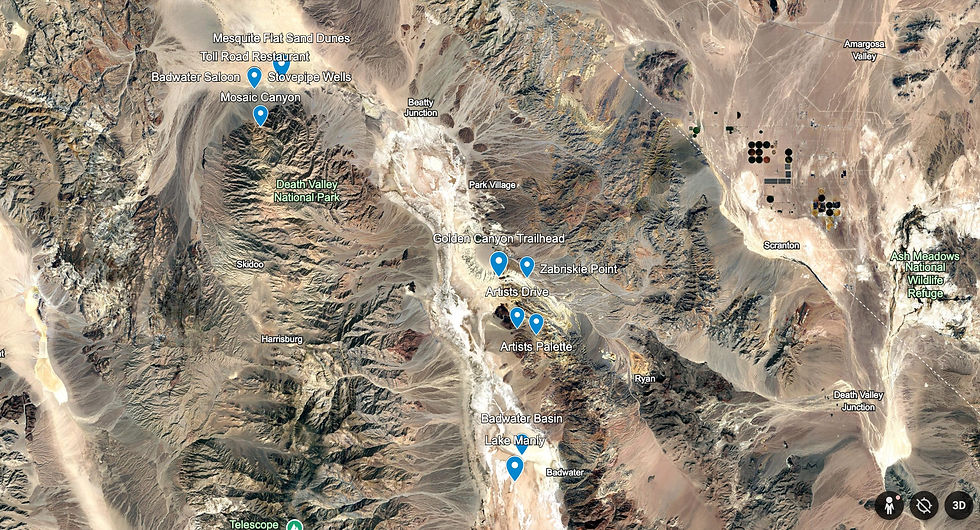
All locations are pinned. View the full map here.
Gear
My go-to for most of this trip was a 24-105. I also leaned on the 16-35. I shoot with a Canon R3, which I love for its low light performance. That matters for night photography and for early morning in challenging conditions. The megapixels are not high but there are always trade-offs. Coming back, I’ll probably play more with my 70-200, especially around the Dunes, and use some wider, fast primes for night photography.
Dogs
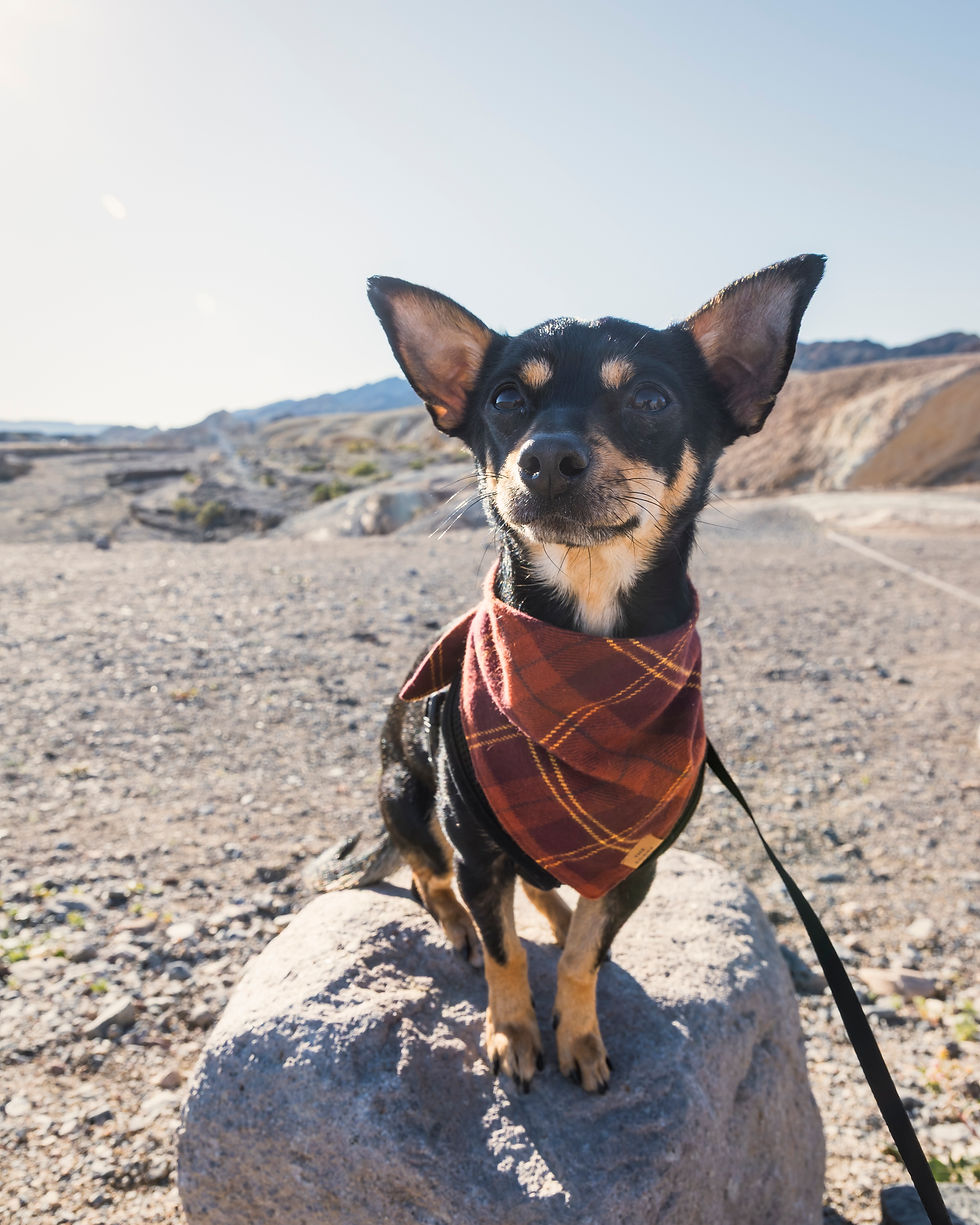
Dogs are allowed in developed areas, campgrounds, parking areas, and along roads, but not on trails. If you are planning to hike at all, I would recommend leaving your dog at home.
Death Valley is a place where you want the freedom to get out and explore, and dogs make that a lot more limiting here.
That said, Louie came with us in February and had a great time riding along between stops. On our first visit, February 16 through 18, temperatures were in the 50s to high 60s, which made brief roadside stops comfortable. When we passed back through on the 27th, it was 90 degrees by mid-morning. Just 11 days later.
So I’d recommend winter only. Check the weather. Bring more water than you think you need. Never leave your dog unattended in the car.
Watch Louie in Death Valley on Instagram
Food / Recovery Stop
If you shoot sunrise at the dunes, the breakfast buffet at Toll Road Restaurant in Stovepipe Wells was surprisingly amazing. Great food and exactly what you want after an early morning out in the wind and sand. Right next door, the Badwater Saloon is also a great place to cool off, regroup, or wait out the heat. Same kitchen. Whatever is happening back there is working.
Where to Stay
Hotels inside the park are expensive, but the access is hard to beat. The Inn at Death Valley is the higher-end option. Beautiful, but pricey. The Ranch at Death Valley is the more casual sister property. Stovepipe Wells Village is often one of the more affordable places to stay inside the park and puts you close to several key spots.
We stayed in Pahrump, Nevada at a dog-friendly Holiday Inn Express because it was about four times cheaper. That worked, but if you want to shoot sunrise, you are adding about an hour and a half of driving before first light.
Next time, I’d probably splurge on at least one night inside the park. If temperatures are reasonable, camping is also worth considering. Furnace Creek Campground takes reservations and is one of the more popular options.
More Death Valley to come. This place deserves a return trip and I will post a part 2. I never got my night shoot out here. Death Valley has some of the darkest skies in the country. That alone is worth going back for. Part 2 will cover Mosaic Canyon, night photography, and everything else I did not get to on this trip. Leave a comment for anything else you’d like me to cover.


Comments